Powered By Blogger

viernes, 8 de abril de 2011

Vocabulary #3


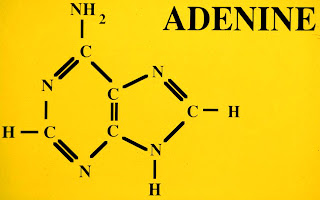
Adenine:A purine; nitrogen-containing basein certain nucleotides.

Bacteriophage:Category of viruses that infect bacterial cells.


Cloning:Making a genetically identical copy of DNA or of an organism.

Cytosine:Pyrimidine; one of the nitrogen-containing bases in nucleotides.

Deoxyribonucleic acid (DNA):Of cells and many viruses, the molecule of inheritance. H bonds join its two helically twisted nucleo tide strands, one of which has instructions (in its base sequence) for synthesizing all of the enzymes and other proteins required to build and maintain cells.

DNA ligase:Enzyme that seals new base-pairings during DNA replication.

DNA polymerase:Enzyme of replication and repair that assembles a new strand of DNA on a parent DNA template.
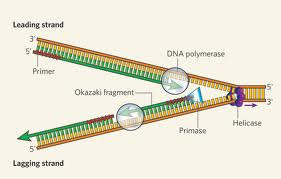

DNA repair:Enzyme-mediated process that fixes small-scale alterations in a DNA strand by restoring the original base sequence.

DNA replication: Any process by which a cell duplicates its DNA molecules before dividing.

Guanine: Nitrogen-containing base in one of four nucleotide monomers of DNA or RNA.

Nucleotide: Small organic compound with deoxyribose (a five-carbon sugar), a nitrogenous base, and a phosphate group. Monomer for adenosine phosphates, nucleotide coenzymes, and nucleic acids.


Thymine:A nitrogen-containing base; one of the nucleotides in DNA (not in RNA).

x-ray diffraction image:Pattern that forms on film exposed to x-rays that have been directed at a molecule; reveals positions of atoms, not the molecular structure.

Anticodon: Series of three nucleotide bases in tRNA; can base-pair with an mRNA codon.

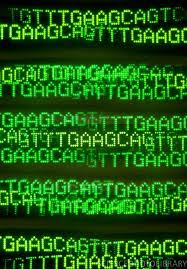
Base sequence: Sequential order of bases in a DNA or RNA strand.
Base-pair substitution: One amino acid has replaced another during protein synthesis.

Carcinogen: Any substance or agent that can trigger cancer.

Codon:One of 64 possible base triplets in an mRNA strand. A code word for an amino acid in a polypeptide chain; a few codons also act as START or STOP signals for translation.

Deletion:At cytological level, loss of a segment from a chromosome. At molecular level, loss of one to a few base pairs from a DNA molecule.

Exon: One of the base sequences of an mRNA transcript that will become translated.

Gene mutation:A small-scale change in the nucleotide sequence of a DNA molecule.

Genetic code:The correspondence between nucleotide triplets in DNA (then mRNA) and specific sequences of amino acids in a polypeptide chain; the basic language of protein synthesis in cells.

Insertion: Insertion of one to a few bases into a DNA strand. Also, a movable attachment of muscle to bone.

Intron: A noncoding portion of a pre-mRNA transcript; excised before translation.

Ionizing radiation: High-energy wavelengths.

mRNA (messenger RNA): A single strand of ribonucleotides transcribed from DNA, then translated into a polypeptide chain. The only RNA encoding protein-building instructions.

Mutation rate: Of a gene locus, the probability that a spontaneous mutation will occur during or between DNA replication cycles.

viernes, 25 de marzo de 2011

vocabulary #2


Abortion: premature spontaneous expulsion of the fetus from uterus.


aneuploidy: having one more or one less chromosome relative to the parental chromosome number.


autosome: any chrosome of a time that is the same in females a


nd males of the specie.


Crossing over:interaction in which non-sister chromatids of a pair of homologous chromosomes break at corresponding sites.


Deletion: loss of a segment from a chromosome.


Diseas: when difenses aren't mobilized fast enought.


Double-blind study: different investigators independently collect, then compare data.


duplication:gene sequence repeated several to may hundrededs or thousan of times.


genetic abnormality:a rare or less common version of a heritable trait.


genetic disoder: any inherited condition that cause mild to severe medical problems.


genetic recombination:result of any process that puts new genetic information into a DNA molecules.


Homologous Chromoseome: one of a pair of chromosomes identicaly in size,shape, and gene sequence.


in-vitro fertilization: conception outside the body.


independent assortmen: Mendelian theory that by the end of meiosis, each pair of homologous chromosomes are stored before shipment to gamets independently of how the other pairs were sorted.


inversion: part of the chromosome that became oriented in reverse.


karyotype: preparation of metaphase chromosome sorted by lenght.


Linkage group: all genes of a chromosome.


mosaicism: cells of same type express genes differently.


Non-disjunction: failure of sister chromatids or pair of homologous chromosomes to separate during mitosis or meiosis.


polyploidy: having three or more of each type of chromosomes in the nucleus of a eukaryotc cell.


reciprocal cross: a paired of cross.


sex chromosome:a chromosome with genes that affect sexual trait.


syndrome:a set of symptoms that may not individually be a telling clue but collectively characterize a genetic disorder or disease.


translocation: movement of a stretch of DNA to a new chromosomal location with no molecular loss.


X & Y chromosome: Are types of sex chromosomes. An XX mamalian embryo becomes female; and a XY embryo becomes male.


jueves, 3 de marzo de 2011

chapter 11- Pattern of Inheritance

1.allele: One of two or more molecular forms of a gene that arise by mutation and code for different versions of the same trait.

2.codominance: In heterozygotes, simultaneous expression of a pair of onidentical alleles that specify different phenotypes.


3.continuous variation: Of a population, a more or less continuous range of small differences in a given trait among its individuals.

4.dihybrid cross: An intercross between two F1 heterozygotes that are identical for two gene loci; the dihybrids are offspring of parents that bred true for different versions of two traits.

5.epistasis: Interaction among the products of two or more gene pairs.

6.F1: The offspring of aninitial genetic cross.

7.F2: The offspring of parents who are the first filial generation from a genetic cross.


8.gene: Unit of information for a heritable trait, passed from parents to offspring.

9.genotype: Genetic constitution of an individual; a single gene pair or the sum total of an individual's genes.

10.heterozygous: Having a pair of nonidentical alleles at a gene locus.

11.homozygo
us dominant: Having a pair of dominant alleles at a gene locus.


12.homozygous recessive: Having a pair of recessive alleles at a gene locus.


13.hybrid: offspring of a genetic cross,offspring having a pair of nonidentical alleles for a trait.

14.incomplete dominance:Condition in which one allele of a pair is not fully dominant; a heterozygous phenotype somewhere between both homozygous phenotypes emerges.


15.independent assortment: Mendelian theory that by the end of meiosis, each pair of homologous chromosomes are sorted before shipment to gametes independently of how the other pairs were sorted. Late

r modified to account for the disruptive effect of crossing over on linkages.

16.monohybrid cross: Intercross between two F1 heterozygotes that are identical for one gene locus; offspring of two parents that breed true for different for

ms of a trait. 17.multiple allele system: Three or more slightly different molecular forms of a gene that occur among individuals of a population.

18.phenotype: Observable trait or traits of an individual that arise from gene interactions and gene-e
nvironment interactions.


19.pleiotropy: Positive or negative effects on two or more traits owing to expression of alleles at a single gene
locus. Effects may or may not emerge at the same time.


20.probability: The chance that each outcome of a given event will occur is
proportional to the number of ways the outcome can be reached.


21.Punnett-square: method Construction of a simple diagram as a way to predict probable outcomes of a genetic cross.


22.segregation: Mendelian theory. Sexually reproducing organisms inherit pairs of genes, the two genes of each pair are separated from each other at meiosis, and they end up in separate gametes.

23.testcross: Experimental cross to determine whether an individual of unknown genoty
pe that shows dominance for a trait is either homozygous dominant or heterozygous.


24.true-breeding lineage
: Of sexually reproducing species, a lineage in which only one version of a trait appears over the generations in all parents and their offspring.

Chapter 11